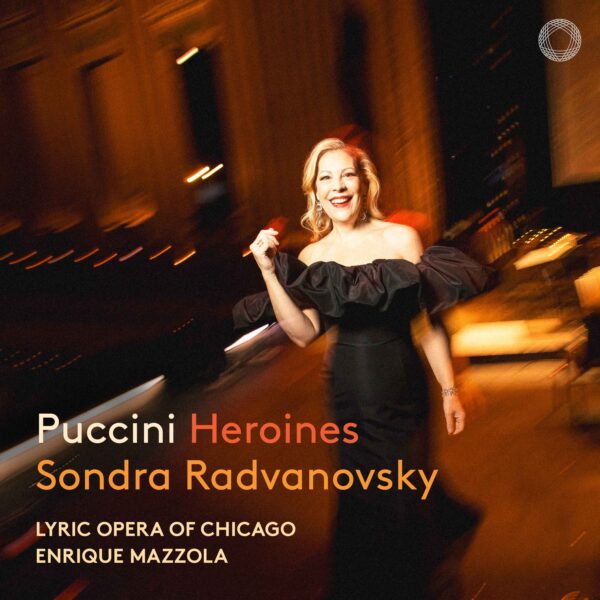
 Photo: Pentatone
Puccini: Heroines
The Women He Killed
No opera composer understood how to “kill” his heroines better than Puccini.
Mimì of La Bohème died. Tosca jumped. Cio-Cio-San took her own life. Liù of Turandot gave her life to keep a secret.
Each of these women died center stage. And Sondra Radvanovsky—one of the great Puccini sopranos of our time—has brought them all back.
This Puccini: Heroines is a feast of arias: from Mimì, Tosca, and Cio-Cio-San to Turandot’s Liù, all sung by a single voice.
Mimì — Farewell
In La Bohème, Mimì sings “Donde lieta uscì” to the poet Rodolfo—“From this happy place I depart,” a farewell.
When Radvanovsky sings this, there is no self-pity in her voice. She sings farewell, but with that gentleness of someone who knows she is dying and does not want to burden the one she loves.
This isn’t a woman crying. This is a woman teaching the man she loves how to go on living.
Tosca — Despair
“Vissi d’arte”—“I lived for art, I lived for love.”
This is Tosca’s prayer as she is being persecuted. Radvanovsky makes this prayer not devout but accusatory—“Lord, I did good all my life, why do you make me suffer like this?”
The weight carried in that sustained note is a trembling you can feel even through a speaker.
Cio-Cio-San — Waiting
“Un bel dì vedremo”—“One fine day we shall see.”
This is the cruelest moment in the opera: a woman waiting for a man who will never return. Radvanovsky sings it full of hope—because Cio-Cio-San truly believes.
We, the audience who know the ending, watch her innocent expectation from below—and the tragedy doubles in weight.
Liù — Sacrifice
“Tu che di gel sei cinta”—“You who are girt with ice.” This is Liù’s farewell in Turandot.
Liù would rather die than reveal Calaf’s name. Radvanovsky’s voice reaches the peak of the whole album here—not a virtuosic high note, but pure, fatal dignity.
After this aria, you understand why Puccini’s women all die, yet none of them is a failure.
One Voice, Four Women
After one album, the same throat carries you through four completely different lives.
Radvanovsky’s gift is that she does not imitate—she lets each character speak for herself. Mimì’s softness, Tosca’s ferocity, Cio-Cio-San’s innocence, Liù’s resolve—all from the same body, yet none repeats the others.
If you can buy only one Puccini aria recital, this is the closest thing to “complete.”
Further Listening
Also on Pentatone, recorded with the Lyric Opera of Chicago under Mazzola, is the world-premiere recording of Missy Mazzoli’s The Listeners—offering a contemporary operatic landscape. And Charlotte Hu’s Goyescas shows passion beyond opera, in pure piano.
About the Performer
Canadian-American soprano (b. 1969). A leading interpreter of bel canto, Verdi, and verismo roles, and a mainstay of the Metropolitan Opera. Renowned for Norma, Tosca, Rusalka, and Donizetti's Tudor queens.
A leading North American opera house founded in 1954.
Spanish-Italian conductor (b. 1968). Music director of the Lyric Opera of Chicago since 2021, a role extended through 2031.
About the Composer
Italian opera composer (1858–1924), master of verismo. Creator of La Bohème, Tosca, Madama Butterfly, and Turandot.
Taiwan Performance History
Soprano Sondra Radvanovsky and conductor Enrique Mazzola have no documented performances in Taiwan. Radvanovsky's career spans well over a thousand performances, with no Taiwan dates found.