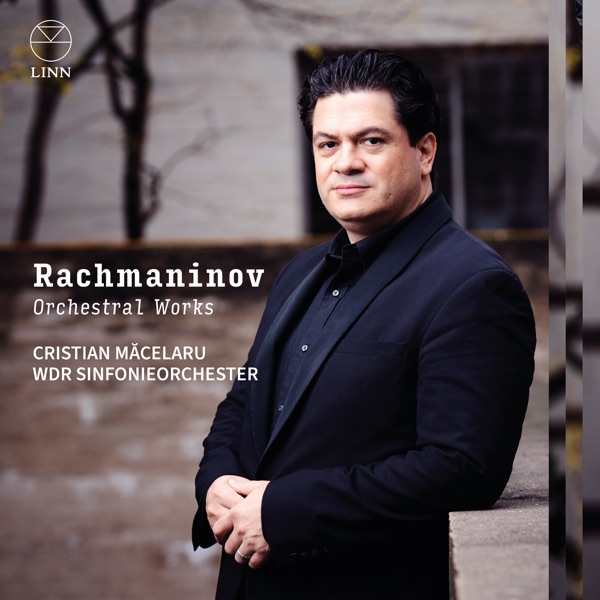
 Photo: Apple Music
Rachmaninoff: Orchestral Works
Slow, But Never Dragging
Rachmaninoff’s Third Symphony is a work easily misunderstood.
It is not the youthful ambition of No. 1, nor the overflowing lyricism of No. 2. The Third was written in Rachmaninoff’s late years, carrying an introverted, complex quality born of hard-won experience.
And this recording by Cristian Măcelaru and the WDR Sinfonieorchester Köln was praised by The Classic Review as “the slowest version you’ve ever heard, yet never dragging.”
Slow, yet never dragging. That phrase captures the soul of late Rachmaninoff precisely.
Freshness of Detail
What most impresses in Măcelaru’s interpretation is its “freshness of detail.”
Many conductors, tackling Rachmaninoff, get lost in his signature romantic melodies and lush orchestral color, overlooking the counterpoint and rhythm hidden within.
But Măcelaru lets those often-buried inner voices surface. You can clearly hear the harp’s touch, the brass’s answers, the woodwinds’ whispers. The critics called this effect “eerie softness”—a beauty at once delicate and tense.
The Third Symphony
This album centers on the Third Symphony, and also includes other Rachmaninoff orchestral works.
The Third’s fascination lies in how it is at once a “symphony” and everywhere carries the presence of Rachmaninoff the pianist—phrases as if conceived by a pianist’s mind, then sung by the orchestra.
That famous second-movement theme—slow, tender, yet distant. Măcelaru has the orchestra play at an extremely restrained volume, so the melody seems to come from far away, which only makes it more moving.
Why Listen
If you think Rachmaninoff’s orchestral output is only the Rhapsody on a Theme of Paganini or the Adagio of the Second Symphony, this album will overturn your assumptions.
It shows Rachmaninoff’s depth as a “symphonic composer”—not just a writer of beautiful melodies, but someone who finds astonishing balance between structure, color, and emotion.
This recording by Măcelaru and the WDR is among the most collectible Rachmaninoff orchestral recordings in recent years.
Further Listening
For more Rachmaninoff-style romance, Mendelssohn’s Scottish Symphony offers another 19th-century romanticism. And Jan Lisiecki’s Preludes explores the piano prelude tradition.
About the Performer
German radio orchestra founded in 1947. Cristian Măcelaru has been its chief conductor since 2021.
Romanian conductor and violinist (b. 1980). Chief conductor of the WDR Symphony since 2021 and music director of the Orchestre National de France.
About the Composer
Russian composer, pianist, and conductor (1873–1943). The Third Symphony (1935–36) is among his late orchestral masterpieces.
Taiwan Performance History
Conductor Cristian Măcelaru has no documented performances in Taiwan. The WDR Sinfonieorchester Köln's December 2025 Asia tour visited Korea and other locations but not Taiwan.