 Photo: Presto Music
Martinů: The Symphonies
Six Symphonies by a Man in Exile
How many homes does a man need to write six symphonies?
Bohuslav Martinů’s answer: all six symphonies were written after he left Bohemia.
He didn’t flee his country. His country was taken from him—first by the Nazi occupation of Prague, then by the communist takeover that followed. He never returned to live there for good.
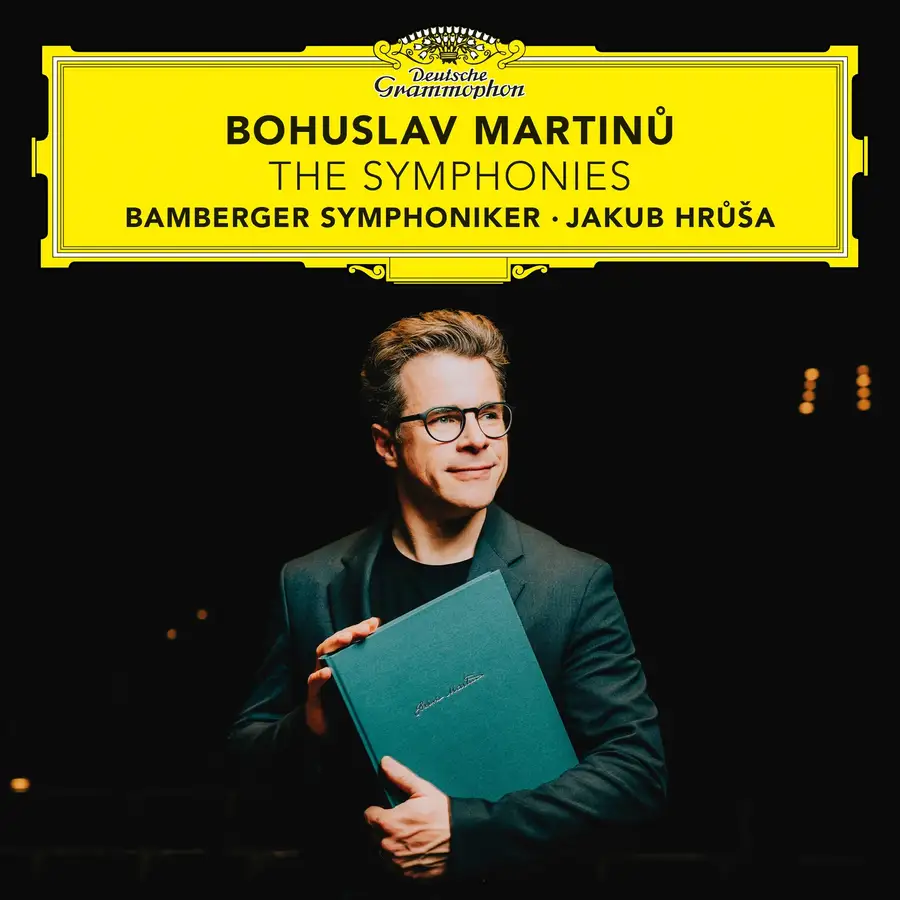
This complete cycle, recorded by the Bamberg Symphony under Jakub Hrůša, is the first time DG has issued all six symphonies together.
No. 1 — The Shape of Homesickness
The First Symphony was written in 1942, shortly after Martinů settled in America.
Its opening brass and percussion carry the rhythmic pulse of Czech folk music—that dual character, at once fiery and lonely, is Martinů’s most distinctive signature.
Hrůša doesn’t play the Czech repertoire with excessive nostalgia. He keeps the rhythms clean and lets the hidden counterpoint surface. This isn’t a man mourning his homeland—it’s a man rebuilding it with music.
No. 4 — The One Called ‘Liberation’
The Fourth Symphony, written on the eve of victory in World War II, is subtitled “Hymn to Liberation.”
The trumpet theme that opens it is short, bright, like the first light of morning.
This is the track I replay most often in the whole set. Hrůša lets the Bamberg brass sing with that trembling hope—not the clamor of triumph, but the still-unbelieving quiet of the moment the war actually ended.
No. 5 — The Shadow After the Light
If No. 4 is liberation, No. 5 is the look back after liberation.
The Fifth Symphony was written in 1946, the first year of peace. There is no triumphant jubilation in the music—instead, a restless current. It’s the bewilderment of knowing the war is over but not knowing what comes next.
In No. 5, Hrůša slows the tempo and lets the orchestral texture reveal more layers. The sustained low strings sound like a man sitting by a window at night, counting the lights going out one by one along the street.
Why Don’t We Know Martinů Better?
In the mainstream Western classical narrative, Martinů has long been filed under “secondary Czech composer”—behind Dvořák, Smetana, and Janáček.
But Hrůša, president of the International Martinů Circle, is changing that.
He has written a book about Martinů. He conducts this complete cycle. He entrusts it to the Bamberg Symphony—an orchestra founded by the descendants of Czech musicians—to play Czech music.
This is no coincidence. It’s a long-overdue, gentle homecoming.
Further Listening
To go deeper into Martinů’s chamber world, the Pavel Haas Quartet’s recording of String Quartets Nos. 2, 3, 5, and 7 is an essential companion. And Pärt’s Complete Symphonies offers another soundscape of 20th-century symphonic music.
About the Performer
German orchestra founded in 1946 in Bamberg by former members of the German Philharmonic of Prague. State Philharmonic of Bavaria, with over 7,500 performances in 64 countries.
Czech conductor (b. 1981). Chief conductor of the Bamberg Symphony since 2016, Music Director of London's Royal Opera House since 2025, and designated Music Director of the Czech Philharmonic from 2028/29. President of the International Martinů Circle.
About the Composer
Czech composer (1890–1959). Wrote all six symphonies during his American exile (1942–1953). A major figure of 20th-century Czech music.
Taiwan Performance History
Conductor Jakub Hrůša and the Bamberg Symphony have no documented performances in Taiwan. Hrůša's Asian footprint is limited to Japan (May 2025, Tokyo's Suntory Hall). No Taiwan dates are currently scheduled.