 Photo: Apple Music
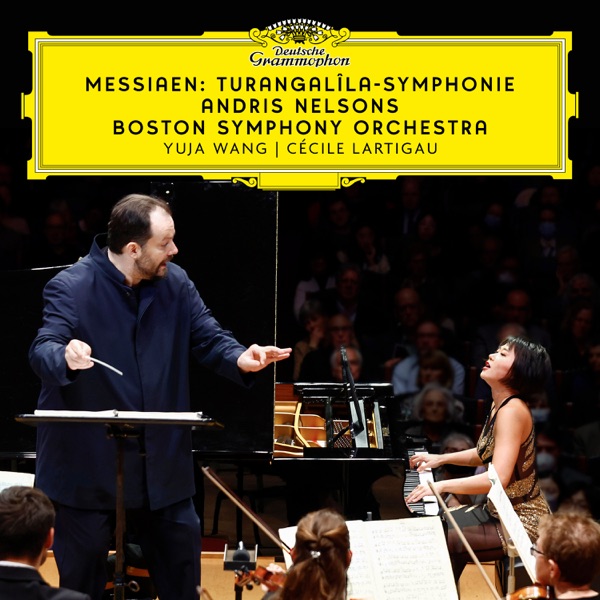
Messiaen: Turangalîla-Symphonie
The Grandest Beast of the 20th Century
Is there a twentieth-century symphony that can make you uncomfortable and breathtakingly beautiful at the same time?
The answer is Messiaen’s Turangalîla-Symphonie.
Written in 1946–48, the work demands a huge orchestra, plus a piano, an ondes Martenot, and a performance lasting about eighty minutes.
Its name comes from Sanskrit: turanga (speed) and lîla (game)—meaning “song of love” or “song of life.”
And this recording brings together Yuja Wang, the Boston Symphony Orchestra, and Andris Nelsons—the very orchestra that gave the world premiere in 1949.
Yuja Wang’s Piano
In Turangalîla, the piano is not an afterthought. It is a core of virtuosity and emotion, carrying an eighty-minute dialogue with the orchestra.
Yuja Wang—the pianist renowned for virtuosity combined with artistry—shows astonishing structural sense here. Those glittering, waterfall-like cascades are handled with both virtuosic thrill and musical logic.
Hear in the first movement the piano and orchestra chasing each other, like two great energies racing to the summit.
The Ondes Martenot
Turangalîla’s most beguiling sonority comes from the ondes Martenot—an early electronic instrument of the last century.
Its sound hovers between voice, strings, and siren—at once gentle and uncanny, with an otherworldly quality. Cécile Lartigau’s playing makes those glissandi drift through the orchestra like phantoms.
Love and Light
Messiaen was a devout Catholic; his music always sings of the sacred. But Turangalîla’s subject is “love” itself—human, passionate, bodily love.
The fifth movement’s “Joie du sang des étoiles” (Joy of the Blood of the Stars) is the ecstatic peak of the whole work—an explosion of rhythm and color, as if the entire universe were celebrating.
Nelsons releases astonishing energy from the Boston Symphony while keeping the structure clear. This is not a chaotic revel—it is ordered, solemn joy.
Why Listen
Released by DG in 2024, with the physical CD arriving in 2025, this is one of the most anticipated Turangalîla recordings in recent years.
It was praised by The Classic Review as interpreting this “grandest beast of the 20th century” with both virtuosity and structural sense.
If you only ever hear Turangalîla once, this is the best choice.
Further Listening
Nelsons’s Shostakovich Lady Macbeth of Mtsensk with the Boston Symphony shows his same command of twentieth-century orchestral and operatic works. And for more of Yuja Wang’s world, Jan Lisiecki’s Preludes album offers piano repertoire.
About the Performer
Chinese-American pianist (b. 1987). One of the world's most celebrated virtuosos.
French player of the ondes Martenot, an early electronic instrument essential to Turangalîla.
Founded in 1881. The BSO gave the world premiere of Turangalîla in 1949.
Latvian conductor (b. 1978). Music director of the Boston Symphony since 2014 and of the Leipzig Gewandhaus Orchestra since 2018.
About the Composer
French composer (1908–1992), deeply influenced by birdsong, Catholic faith, and non-Western rhythm. Turangalîla (1946–48) is among his grandest orchestral works.
Taiwan Performance History
Pianist Yuja Wang gave a recital in Taiwan in 2015, returned for recitals on May 26, 2026 (Taipei National Concert Hall) and May 27, 2026 (Kaohsiung Weiwuying), and will lead a Taiwan-wide tour with the Mahler Chamber Orchestra in November 2026, her conducting debut. Conductor Andris Nelsons made his Taiwan debut with the Leipzig Gewandhaus Orchestra on May 23–24, 2026 (Taipei National Concert Hall and Tainan).