 Photo: Apple Music
Mahler: Symphony No. 7
Four Shapes of Night
Mahler’s Seventh Symphony has a nickname—“Song of the Night.”
It is not an official title, but it captures the symphony’s soul precisely. Mahler here deals not with a single night, but with many faces of night.
There are five movements. Two of them Mahler explicitly marks as “Nachtmusik” (night music).
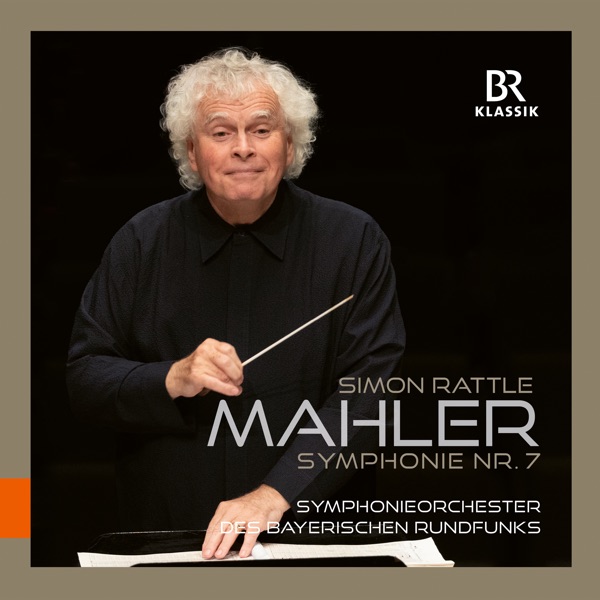
This recording by Simon Rattle and the Bavarian Radio Symphony Orchestra was named a top-ten candidate for 2025 by The Guardian, described as “hair-raisingly vivid.”
The First Night
The opening movement carries Mahler’s characteristic marching rhythm—like an invisible army slowly advancing through the dark.
The plucked basses and cellos, joined by harp and brass, create an atmosphere both solemn and uneasy. Rattle keeps this opening at just the right tension—not frightening, but letting you know this night is not entirely calm.
The Two Night Musics
The second movement, “Nachtmusik I,” draws on a famous inspiration—Mahler claimed it was influenced by Beethoven’s Eighth Symphony and Schubert’s song cycles.
The fourth movement, “Nachtmusik II,” is more intimate, built on guitar and mandolin chords, like a serenade played late at night.
In Rattle’s hands, these two night-music movements take on completely different tones—one an outdoor, uneasy night; the other an indoor, private night.
The Finale — Dawn
Mahler rarely gives you a purely “happy ending.” But the Seventh’s finale is, surprisingly, bright and carnivalesque.
This confuses many listeners. Rattle’s interpretation takes a middle path: he keeps the exuberance while hinting at unease—like the forced cheer of someone who has stayed up all night, applauding at daybreak.
Why This Recording
Rattle’s relationship with Mahler runs deep. He has recorded almost all of Mahler’s symphonies, and this Seventh is one of his three recordings of the work.
Many critics consider this BR Klassik version the finest of his three Sevenths—because it captures the energy of the BRSO’s live recording, and because Rattle’s understanding of this complex work reached maturity here.
If you’re new to Mahler, the Seventh isn’t the best place to start. But if you’re ready to be utterly overwhelmed by a symphony, this album is hard to beat.
Further Listening
Rattle is also a superb interpreter of Janáček’s operas. His recordings with the London Symphony Orchestra of Jenůfa and The Excursions of Mr Brouček show the same dramatic acuity.
About the Performer
German orchestra founded in 1949, one of the world's finest. Simon Rattle has been its chief conductor since 2023.
English conductor (b. 1955). Chief conductor of the Berlin Philharmonic (2002–2018), then music director of the London Symphony Orchestra, now chief conductor of the BRSO. Multiple Taiwan visits.
About the Composer
Austrian composer and conductor (1860–1911), whose symphonies expanded the genre to unprecedented scale.
Taiwan Performance History
Simon Rattle visited Taiwan multiple times with the Berlin Philharmonic between 2005–2016. In December 2024 he toured Taiwan with the Bavarian Radio Symphony Orchestra (Taipei National Concert Hall, Taichung, Kaohsiung's Weiwuying). In November 2026 he returns with the BRSO: 11/15 Kaohsiung Weiwuying, 11/16 Taichung Opera, 11/18–19 Taipei National Concert Hall (Mahler's 'Resurrection' Symphony).