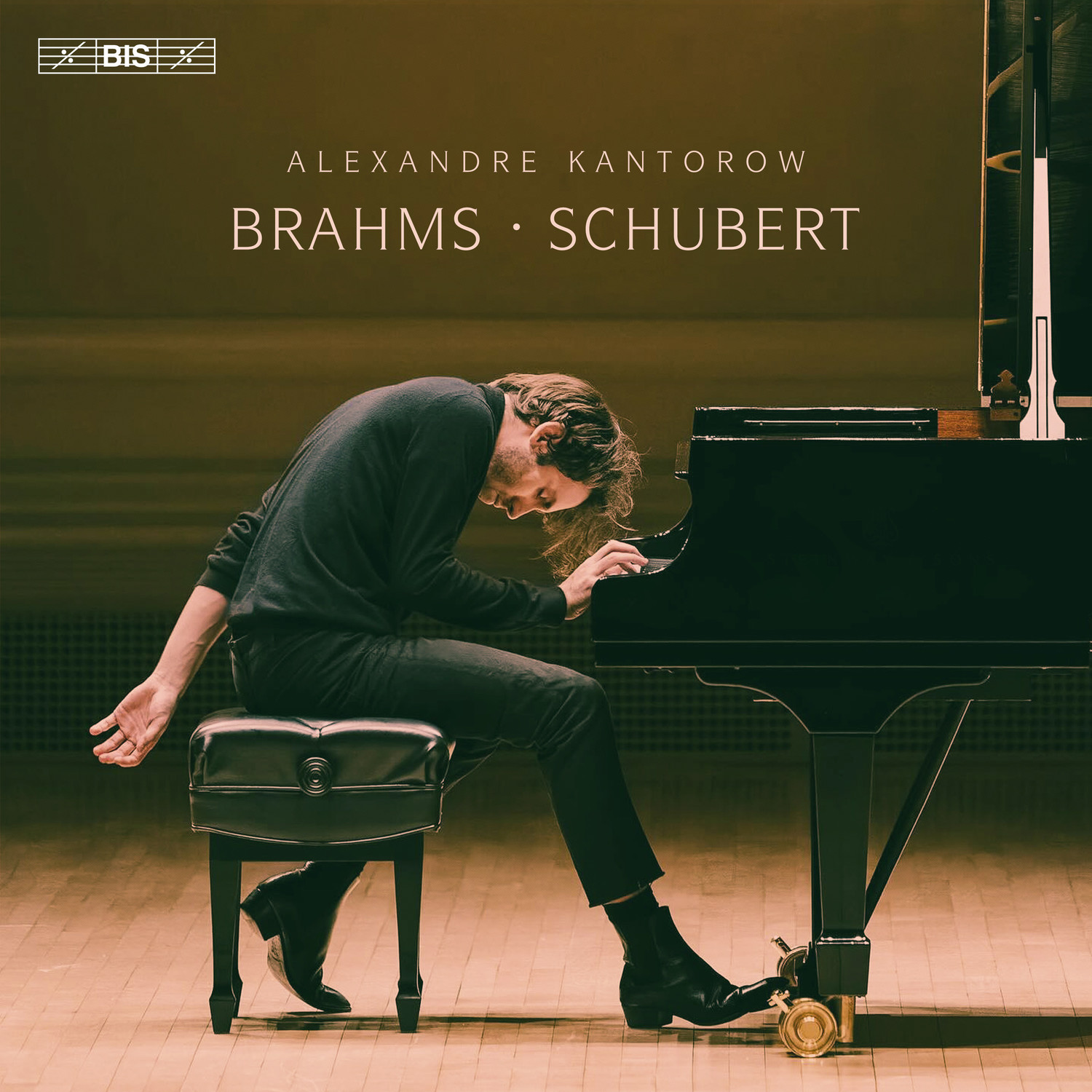
 Photo: BIS Records / eClassical
Brahms: Piano Sonata No. 1 / Schubert: Wanderer Fantasy
A Knock on Schumann’s Door
On the morning of September 30, 1853, a dusty twenty-year-old youth from Hamburg stood before an apartment in Düsseldorf, carrying a worn knapsack.
His name was Johannes Brahms. When Robert Schumann opened the door and ushered the young man to the upright piano, Schumann expected polite courtesy. But when Brahms’s hands struck the monumental opening chords of his Piano Sonata No. 1 in C major, Op. 1—reminiscent of Beethoven’s Fifth—Schumann leapt to his feet and called for his wife Clara: “Come, Clara, listen! Here is someone who will change music forever!”
Over a century and a half later, French virtuoso Alexandre Kantorow—widely celebrated as a modern reincarnation of Liszt—recorded this program for BIS Records, claiming the 2025 Gramophone Piano Award.
An Orchestral Volcano Veiled in Ivory
Listening to Kantorow navigate Brahms Op. 1, what takes the breath away is the bottomless depth of his touch.
He never bangs; rather, he channels his entire upper body weight through firm knuckles directly into the keybed. The massive octaves that mimic a full orchestral tutti resound with dark bronze resonance. Yet in the second movement variations on the old German folk song Verstohlen geht der Mond auf, his tone dissolves instantly into pale moonlight reflected in a castle moat—pure, chaste, and imbued with quiet yearning.
In Schubert’s Wanderer Fantasy D 760, Kantorow unleashes breathtaking keyboard mastery. This was the terrifying score over which Schubert himself famously threw up his hands in despair, muttering: “Let the devil play it!” Across its four interconnected movements, Kantorow turns the work into a metaphysical pilgrimage.
In the Adagio (“I come from the mountains, the valleys are dim, the sea sighs…”), his piano descends into somber baritone depths, capturing the 19th-century wanderer’s eternal quest for home.
The Youthful Giant’s Long Road
The album concludes with five of Liszt’s luminous Schubert song transcriptions, including Am Meer and Die Stadt. Here, Kantorow makes the piano sing with human vocal inflection, breathing through every phrase like a lieder singer.
This is not an album to play as casual background music. It asks for an uninterrupted hour in a quiet room, walking in the footsteps of a twenty-seven-year-old master who channels both the fiery bravado of young Brahms and the heartbreaking wanderlust of Schubert.
When the final resonant chord fades into the listening room, one understands the tears in Schumann’s eyes that September morning: the profound shudder of an artistic spirit arriving safely home.
About the Performer
French pianist (b. 1997, Clermont-Ferrand). 2019 International Tchaikovsky Competition Gold Medal and Grand Prix winner, 2024 Gilmore Artist Award recipient. Winner of the 2025 Gramophone Piano Award for this recording. Celebrated as the 'fire-breathing reincarnation of Liszt'.
About the Composer
German master composer (1833–1897). His Piano Sonata No. 1 in C major Op. 1 (1853) was hailed by Robert Schumann as the arrival of an 'orchestral giant veiled in piano clothing'.
Austrian early Romantic master (1797–1828). The Wanderer Fantasy in C major D 760 (1822) pushes keyboard virtuosity to its extreme limits in an unbroken cyclical structure.
Hungarian Romantic keyboard virtuoso and composer (1811–1886), renowned for brilliantly expressive piano transcriptions of Schubert lieder.
Taiwan Performance History
French pianist Alexandre Kantorow has toured Taiwan twice: performing concertos with Jaap van Zweden and the Orchestre Philharmonique de Radio France at Taipei National Concert Hall (May 22, 2026) and Weiwuying (May 23, 2026), alongside solo recitals in December 2024.